When a business wants to turn a logo, illustration, or design into embroidery, accuracy matters. A digital design may look perfect on a computer screen, but embroidery works differently. It uses stitches, thread, fabric, tension, and machine settings to recreate the artwork. 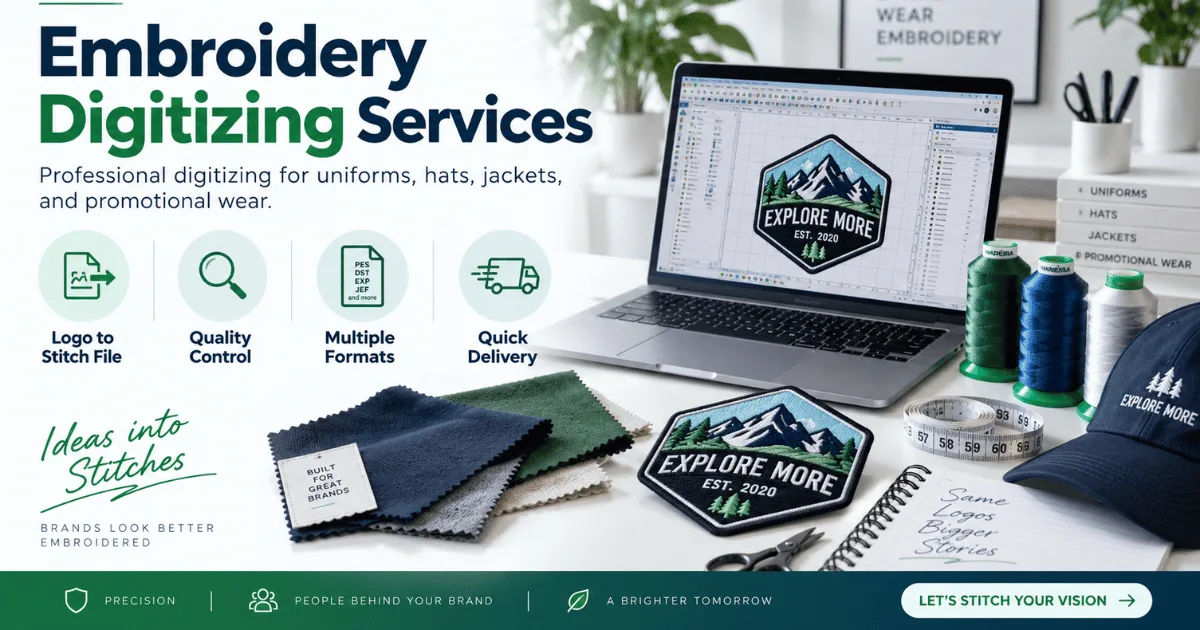
This is why many businesses turn to Professional Embroidery Digitizing & Vector Art Services when they need reliable artwork for embroidery and other production purposes. These services convert designs into usable digital files while considering details such as stitch direction, density, spacing, outlines, and fabric behavior.
Accuracy is especially important for businesses that use logos on uniforms, hats, jackets, promotional products, and branded clothing. A poorly prepared file can produce uneven stitches, distorted shapes, incorrect proportions, or unreadable lettering. A professionally prepared file can significantly reduce these problems and provide a cleaner finished product.
What Does Accuracy Mean in Embroidery Digitizing?
Embroidery digitizing is more than simply converting an image into a machine-readable format. It involves creating a stitch plan that tells an embroidery machine how to reproduce the artwork.
An accurate digitized design should preserve the important visual characteristics of the original artwork. This includes the shape, proportions, colors, lettering, outlines, and overall appearance.
However, accuracy does not mean that every tiny detail must be reproduced exactly. Embroidery has physical limitations. Extremely small details may not work well with thread, and thin lines may need adjustment to remain visible.
A skilled digitizer understands these limitations and makes controlled changes without damaging the identity of the original design.
Accuracy Depends on the Artwork
The quality of the original artwork has a major effect on the final result. A high-resolution logo with clear shapes and defined colors is easier to digitize accurately than a blurry screenshot.
For example, a clean vector logo provides precise information about curves, lines, and shapes. A low-quality JPEG may contain compression artifacts and unclear edges.
A professional digitizer can often improve or interpret imperfect artwork, but the more information available in the original design, the easier it is to produce an accurate result.
How Accurate Are Professional Embroidery Digitizing & Vector Art Services?
In most cases, experienced Professional Embroidery Digitizing & Vector Art Services can produce highly accurate results when the artwork, specifications, and production requirements are clearly provided.
The goal is not simply to make a digital file that opens on an embroidery machine. The goal is to create a file that produces a visually accurate and structurally reliable embroidered design.
Professional digitizers consider how different stitches will behave on the selected fabric. They also consider the embroidery size, machine type, thread, backing, and design complexity.
For example, a logo intended for a cotton shirt may require different settings from the same logo embroidered on a structured cap. The design may need different stitch directions, densities, and underlay techniques.
Stitch Placement Matters
One of the biggest factors affecting accuracy is stitch placement.
Every section of an embroidery design needs an appropriate stitch type and direction. Satin stitches are often used for borders, lettering, and narrow shapes. Fill stitches work well for larger areas, while running stitches can be useful for fine details.
If stitches are placed incorrectly, the embroidered result may look uneven or distorted.
Professional digitizers carefully plan the stitch sequence so different sections connect properly and maintain the intended appearance.
Stitch Density Must Be Controlled
Stitch density refers to how closely stitches are placed together.
Too few stitches can leave gaps and make a design look weak. Too many stitches can create excessive thickness, cause thread buildup, or make the fabric pucker.
Accurate digitizing requires a balanced density based on the fabric and design.
A professional digitizer knows that one density setting cannot work for every material. Denim, fleece, cotton, performance fabric, and caps can all respond differently to embroidery.
The Role of Vector Art in Accuracy
Vector artwork is particularly valuable when accuracy is important. Unlike raster images, vector graphics are based on mathematical paths. This means they can usually be resized without losing their sharpness.
A logo created as vector artwork can maintain clean edges when enlarged or reduced. This makes it useful for embroidery, screen printing, signage, promotional products, and other applications.
Professional Embroidery Digitizing & Vector Art Services often include vectorization because businesses may not have suitable artwork available for production.
Why Vectorization Improves Design Preparation
A raster image may contain blurry edges, unwanted backgrounds, and inconsistent lines. Vectorization recreates the artwork using clean shapes and paths.
This process can make it easier to identify individual design elements.
For example, a company logo may contain a symbol, text, border, and several color areas. A vector artist can separate these components and create a clean production-ready file.
This does not automatically guarantee perfect embroidery, but it provides a stronger foundation for accurate digitizing.
Factors That Affect Accuracy
Several factors determine whether a digitized design will match the original artwork.
Design Size
Embroidery designs behave differently at different sizes. A detailed logo that looks excellent at eight inches may become difficult to reproduce at two inches.
When a design becomes smaller, tiny gaps and narrow lines can disappear.
A professional digitizer may simplify certain details while preserving the overall appearance of the logo.
Fabric Type
Fabric is another major factor.
Stretchy materials can cause distortion if the design is not properly prepared. Thick materials may require different underlay and density settings. Caps have curved surfaces that create additional challenges.
Because of these differences, accurate digitizing should be based on the actual production environment rather than only the appearance of the artwork on a computer.
Thread Selection
Thread color and thread characteristics can influence the finished result.
Two thread colors that appear similar on a screen may look different when stitched. Thread has its own shine, texture, and reflective qualities.
Professionals take these differences into account when preparing artwork for embroidery.
Machine Settings
Even an excellent digitized file can produce inconsistent results if the embroidery machine is poorly maintained or incorrectly adjusted.
Thread tension, needle condition, hooping, speed, and other machine factors can affect the finished embroidery.
This means digitizing accuracy and production accuracy are related but not identical.
How Professionals Check Their Work
A reliable digitizing process usually includes some form of quality control.
The digitizer may inspect the stitch sequence, check the design at actual size, review stitch density, and look for possible problem areas.
Many professionals also use embroidery software simulations. These previews can show how the design is expected to stitch before it is sent to the machine.
However, a software preview should not always be considered a replacement for physical testing.
Test Stitching Is Important
A test stitch-out is one of the best ways to evaluate embroidery accuracy.
The design can be embroidered on a material similar to the customer's actual product. This reveals problems that may not be obvious on a computer screen.
The digitizer can then make adjustments to density, underlay, pull compensation, stitch direction, or sequencing.
This process helps transform a technically correct design into a production-ready design.
What Is Pull Compensation?
Pull compensation is an important concept in embroidery digitizing.
When thread is stitched into fabric, certain areas can pull inward or become narrower. This can affect the shape of letters, borders, and other elements.
Digitizers compensate for this natural movement by slightly adjusting parts of the design.
Without appropriate compensation, a logo may not look exactly like the original artwork after stitching.
Experienced Professional Embroidery Digitizing & Vector Art Services understand how to account for these physical changes.
Can Accuracy Be Guaranteed?
No embroidery service can realistically guarantee that an embroidered design will be identical to a digital image in every microscopic detail.
Embroidery is a physical process, not a screen-based reproduction method.
Thread thickness, fabric texture, machine behavior, and lighting can all affect the appearance of the finished design.
However, professional digitizing can greatly improve consistency and visual accuracy.
A good service should aim to preserve the most important characteristics of the original artwork while adapting it appropriately for embroidery.
Signs of a High-Quality Digitizing Service
Businesses should look for several qualities when selecting a digitizing provider.
First, the service should understand different embroidery applications. Experience with shirts does not necessarily mean the same person has extensive experience with caps, jackets, bags, or specialty fabrics.
Second, the provider should be willing to review the artwork and discuss production requirements.
Third, the service should understand stitch types, density, sequencing, underlay, and pull compensation.
Fourth, they should be capable of producing common embroidery file formats when required.
Good communication is also important. A digitizer who asks about the fabric, size, placement, and intended use is usually better positioned to create an appropriate file.
Common Causes of Inaccurate Embroidery
Understanding common problems can help businesses avoid disappointing results.
One common issue is excessive detail. Small details may not translate effectively into stitches.
Another problem is incorrect density. Too many stitches can make the design heavy, while too few can make it look incomplete.
Poor sequencing can also cause visible problems. Some elements may overlap incorrectly or create unnecessary thread changes.
Incorrect sizing is another frequent issue. A design prepared for one embroidery area may not work well when dramatically resized.
Finally, using the wrong file for the machine can cause production problems. The digitizing provider should understand the machine format required by the customer.
Are Vector Art Services Accurate?
Vector art services can be highly accurate when the original artwork is clear and the artist understands the desired result.
The purpose of vectorization is to recreate artwork as clean, scalable paths. A skilled artist carefully traces curves, adjusts shapes, recreates typography, and separates colors.
Accuracy becomes more challenging when the source image is blurry, extremely small, damaged, or incomplete.
In these situations, the artist may need to interpret missing information. This requires design judgment rather than simple tracing.
Why Businesses Benefit From Professional Services
For a business, accurate artwork can save time and reduce production problems.
Instead of repeatedly correcting the same logo, a company can maintain a properly prepared master file for future orders.
This is particularly useful for businesses that produce branded clothing in different sizes and materials.
Professional Embroidery Digitizing & Vector Art Services can also help businesses maintain visual consistency across multiple products.
A company logo should look recognizable whether it appears on a polo shirt, work jacket, cap, or promotional bag.
Professional preparation helps achieve that consistency while accounting for the requirements of each application.
Questions to Ask Before Ordering
Before sending artwork to a digitizing provider, businesses should ask a few practical questions.
What file format will be delivered?
Will the design be optimized for the intended fabric?
Is a revision included if the test stitch-out reveals a problem?
Can the provider prepare artwork for caps or three-dimensional applications?
Does the service have experience with small lettering?
These questions can help identify whether a provider understands production requirements rather than simply converting images.
How to Improve Your Own Results
Customers can also improve accuracy by providing useful information.
Send the highest-quality artwork available. Clearly explain the intended embroidery size and placement.
Mention the fabric type and product whenever possible.
If exact brand colors matter, provide appropriate color references rather than relying only on a computer display.
It is also helpful to explain whether the design will be used on shirts, caps, jackets, bags, or another product.
The more production information the digitizer receives, the better the final file can be customized.
Professional Digitizing Versus Automatic Conversion
Automatic image conversion tools can be useful for simple experiments, but they often cannot understand the physical requirements of embroidery as effectively as an experienced digitizer.
Automatic tools may assign stitches based primarily on image shapes. They may not properly account for fabric stretch, stitch direction, density, or pull compensation.
Professional digitizing involves human judgment.
A skilled digitizer can decide which details should remain, which should be simplified, and which stitch types are most suitable for each part of the design.
For businesses producing customer-facing products, this level of control can be valuable.
The Importance of Revisions
Even a carefully prepared design may need adjustments after testing.
This is not necessarily a sign of poor workmanship. Embroidery involves many variables, and physical testing can reveal issues that were difficult to predict.
A professional provider should be able to make reasonable adjustments when necessary.
For example, small lettering might need to be slightly enlarged, or a dense area might need fewer stitches.
The objective is to achieve the best practical result while maintaining the original design's identity.
PSA Digitizing makes it easier to transform artwork and logos into professional machine embroidery designs. The company specializes in creating embroidery-ready files in formats including DST, PES, JEF, and more. Based in Clarkston, Georgia, USA, the team combines technical digitizing knowledge with modern software to ensure designs are properly prepared for stitching while maintaining important details and clean finishes.
For embroidery businesses and hobbyists, dependable service can make a major difference, and PSA Digitizing focuses on delivering exactly that. With a 4.5+ star rating on Trustpilot, the company has built customer confidence through quality workmanship and quick, reliable turnaround. From logo digitizing to custom patches and machine embroidery files, PSA Digitizing offers practical solutions for different embroidery needs. Visit psadigitizing.com to get started.
Conclusion
So, are Professional Embroidery Digitizing & Vector Art Services accurate? Yes, they can be extremely accurate when handled by experienced professionals and supported by good-quality artwork and proper production information.
Accuracy in embroidery is different from simply copying an image. A successful design must account for fabric, thread, stitch type, density, sequencing, machine behavior, and the physical movement of the material.
Professional digitizers understand these factors and adapt artwork accordingly. They can also use vector art to create cleaner, scalable designs that provide a strong foundation for embroidery and other forms of production.
The best results usually come from a combination of high-quality artwork, skilled digitizing, suitable machine settings, and test stitching. Businesses should therefore judge a service not only by how attractive its digital previews look but also by its understanding of real embroidery production.
Professional Embroidery Digitizing & Vector Art Services are especially valuable for businesses that depend on consistent branding. When a logo needs to appear on different garments and products, professionally prepared artwork can help maintain recognizable shapes, clean lettering, and balanced stitching.
No digitizer can eliminate every physical variable involved in embroidery. However, experienced professionals can anticipate many common problems and make the necessary adjustments before production.
Ultimately, accuracy comes from combining technical knowledge with design experience. Choosing a skilled provider, supplying clear artwork, explaining production requirements, and reviewing test results can make a significant difference.
For businesses that care about professional presentation, investing in quality digitizing and vector preparation is not simply an extra step. It is part of producing embroidery that looks clean, consistent, durable, and true to the original brand.
About the Author